
Honestly, the idea for my play, Earworm, came after a breakup. My mind was everywhere: sadness, sex, spirituality, intermittent fasting, plant growing, and most of all, music. Instead of picking the scabs of my breakup and ruminating over mistakes, I scratched for sounds and lyrics—the more familiar and epic, the better. My mind started exploding with this emotional bulimia, but I had no capacity or poise to write down anything other than a quick verse on a Post-it. A couple of weeks later, my only vase was filled with yellow Post-its, crammed with buds of statements that looked like withering petals.
As time went by, I started healing, and as part of my process, I read Out of the Shadows by Walt Odets, recommended by practically everyone on Hinge. This masterpiece highlighted so much about how some of us queer people are afraid to be loved, how we are not accustomed collectively to having intimacy, so much so that losing a relationship becomes part of our fantasy, perpetuating our fear and cycle of not feeling wanted. I had to admit that my obsession with songs was another way of creating a fantasy around a loss. This insight is poured into the protagonist’s confusion between love, validation, and performance.
With this futile mechanism, we enter relationships, making mistakes that sometimes feel like an endless loop. Rinse and repeat. As our tactics are so precarious, the relationship inevitably falls apart; there’s no clean ending. No closure. Just a painfully catchy song stuck in your head while you stare at a WhatsApp chat at 3am, rereading messages like they might suddenly change meaning.
Coming to Camden People’s Theatre this August, the show is an anti-rom-com, acerbic, chaotic and relatable. It could leave you with a bittersweet feeling, which may be true for every recovery journey, artistic process, and romantic relationship.
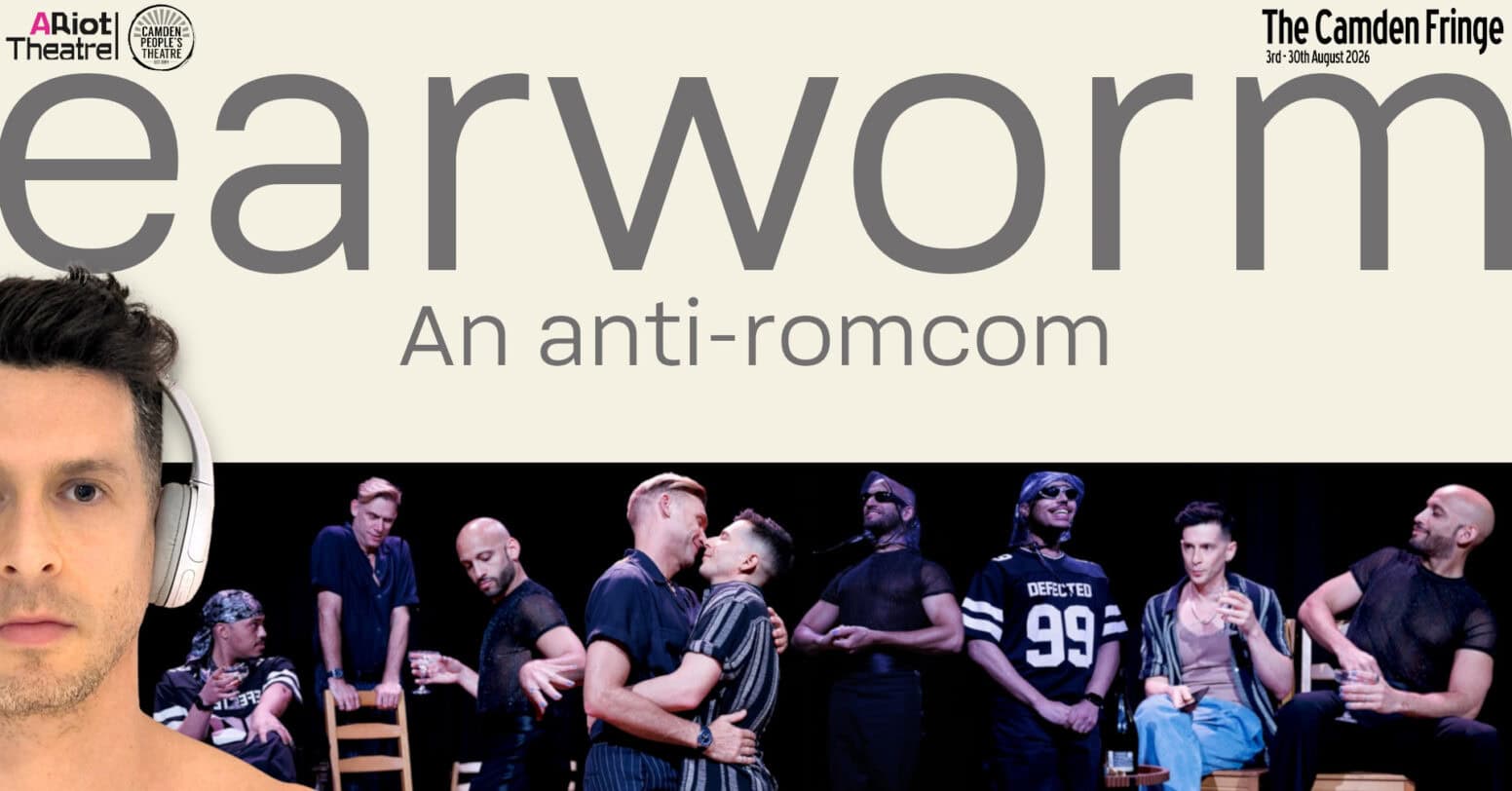
At the centre are Guy and his older boyfriend, John. Thirty-plus meets forty-plus; both knew how they complemented each other, but now all they can see is the fraction in the middle where their two pieces attach—and it is not a golden kintsugi line, but a border riddled with conflict and dispute. In that state of friction, different germs breed inside the petri dish of queer life: transactional hookups, generational clashes, and the way pop culture and sarcasm become ways of deflecting but also vehicles into our true feelings, like Abigail’s Party for the common gay specimen.
The avoidant nature of the characters—the fear of real intimacy, of genuinely being seen—means that to grapple with their feelings, they must package their emotions into a framework that makes sense: a song.
It is also mirrored in the way the piece was written. Amidst a breakup, like all breakups, it is divided into five stages, the same structure that forms the perfect pop song. The classic pop song structure: Intro, Verse, Pre-Chorus, Chorus (THE HOOK), the emotional payoff (every good breakup has at least one of those), Bridge (where a deeper insight is revealed), Outro—wraps up the song (fade out, a snap, or a clean ending? In breakups, it is usually a combination of all of the above).
From the start, the show refuses to behave. Guy breaks the fourth wall immediately, questioning the audience, the space, and the entire idea of theatre itself. He’s not just telling a story; he’s pitching his failed relationship like it’s an arts grant application, desperately trying to justify his own emotional chaos to a room full of strangers.
That’s why Camden Fringe and Camden People’s Theatre in particular felt like fertile ground for this show to live. It’s raw, self-aware, and slightly feral. If you’ve ever used a song to survive an ex, danced in the living room while crying, or quoted lyrics to your therapist to get your point across… this one’s for you.
Earworm runs runs from 18–22 August at 9pm at at Camden People’s Theatre, 58-60 Hampstead Road, London NW1 2PY, United Kingdom.
By Gur Arie Piepskovitz





![The Rising in London's SE1 is an LGBTQ] bar that has many LGBTQ] social events](https://www.qxmagazine.com/wp-content/uploads/2024/09/imageedit_26_9160770370-728x410.jpg)