Foregrounding the ritual qualities of performance through an intergenerational and international programme, this year’s CEREMONY festival is curated by Joseph Morgan Schofield. The festival considers how queers, migrants, and others who inhabit the outsides and undersides have tended to mystery, ritual, and connection in the shadow of empire and industry.
CEREMONY 2026 is Future Ritual’s most ambitious programme to date, following a sell-out edition of the festival in 2025.
Queer highlights of CEREMONY 2026
Curtain Call, a new work from Pianka Pärna, Wednesday, 25 November.
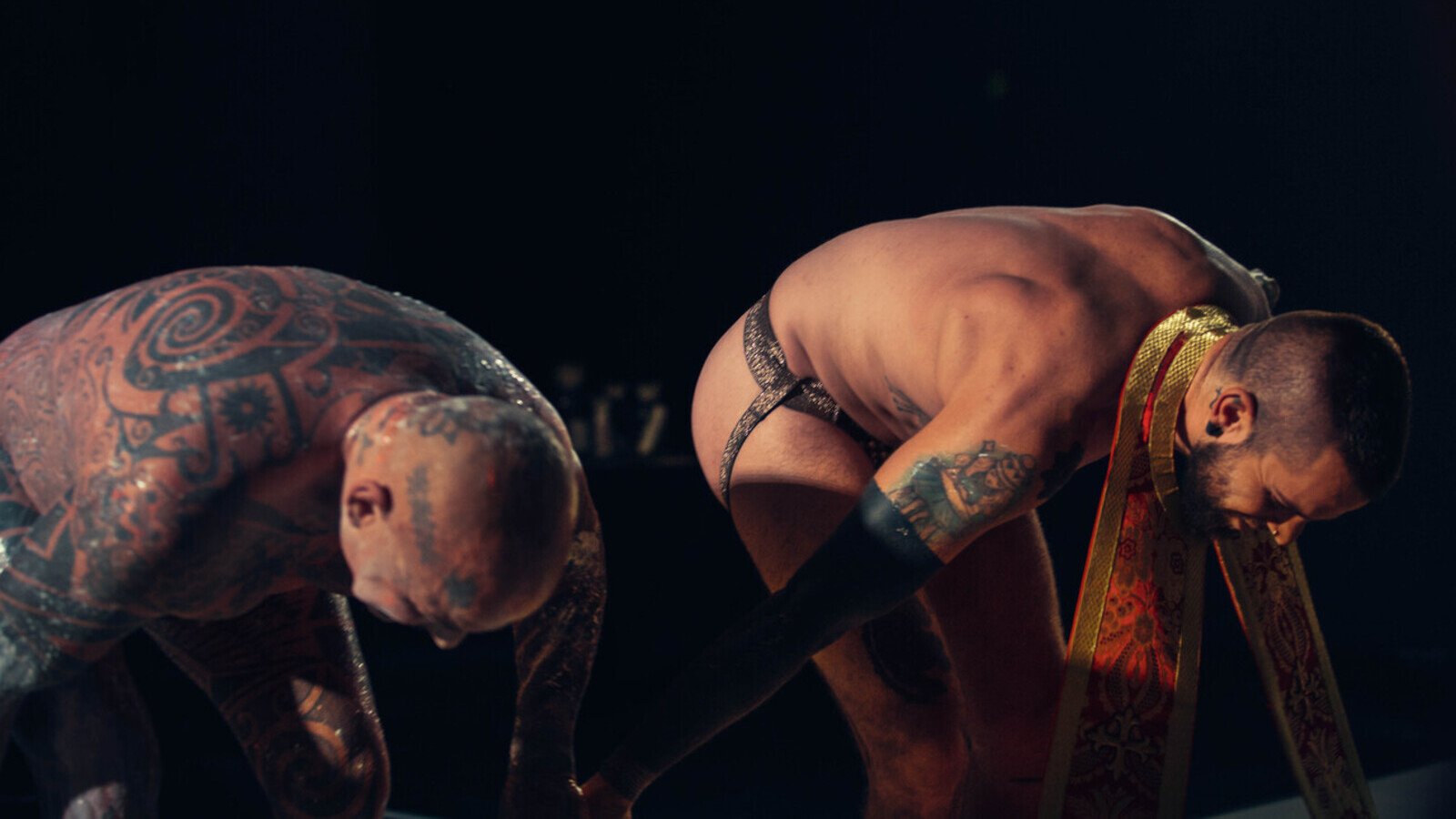
Launching the festival, Curtain Call from Pianka Pärna is a live art ballet in which performers Wet Mess, Nando Messias, and Claudia Palazzo work to undo the perfection of classical ballet training in the context of queer identity and post-Soviet displacement. Curtain Call is accompanied by a live score by Leo Chapman.
Set in a landscape where the traditions and discipline of ballet meet Eastern European folklore, Curtain Call inhabits a surreal landscape of grotesque ballet artists, all of whom are tired of perfection and hungry for wildness.
Through a visceral and sensory lens, Curtain Call touches upon themes of oppression, liberation, occupation and independence as well as BDSM, queerness, authority and consent. As bodies are cinched into PVC latex suits alongside headpieces referencing the baby-hungry Baba Yaga, pointe shoes and fetish-inflected ballet objects collide to create a world where classical beauty is deconstructed. Referencing both Slavic mythology and contemporary body culture and modification, the visual language of Curtain Call asks what perfection conceals and what it reveals.
Originally from Estonia, Pärna studied ballet to an advanced level before an injury forced them to stop:
“At 17, I was told I had to choose between ballet and walking. Curtain Call began with a question I couldn’t stop asking myself back then: What happens when the body you’ve spent your whole life trying to perfect can no longer survive the system that shaped it? Being young and in pain was normal, and unlearning this notion has formed part of my artistic practice after retiring from ballet.”
Growing up in a post-Soviet culture taught me that perfection isn’t just an aesthetic; it’s also a political language. I’m interested in inherited choreographies – the ways history continues to shape our bodies long after the curtain falls. This isn’t a performance about ballet; it’s a performance about what ballet can teach us about power and our society today.”
About Pianka Pärna
Pianka Pärna (they/them) is a post-Soviet artist from Estonia whose performance practice explores post-Soviet identity, queer embodiment, Baltic mythologies, and the politics of the body. Pianka’s practice is shaped by 6 years of Vaganova-method ballet training at Tallinn Ballet Academy, alongside 3 years at Broadway Dance Center in New York City, where they trained across commercial forms and performed in Off-Broadway productions. A UK resident for over 9 years, Pärna has performed extensively in the UK, US, and Europe. @piankaperformance
Curtain Call co-performers:
Wet Mess (they/them) works across drag, movement direction, theatre, and live art. In 2021, they won Not Another Drag Competition (Royal Vauxhall Tavern) and have since largely worked in drag, cabaret, and nightlife. @wet_mess
Nando Messias (they/them) explores performance art, dance and theatre. Their performances combine their signature take on beauty with a fierce critique of gender, visibility and violence. @nancymessias
Claudia Palazzo (she/they) is a London-born artist working at the intersections and contradictions of dance, performance art, installation, and sound. Influenced by roots in psychophysical training, inner-city structures, and nightclub culture, allowing space for dissociation and reassociation as a way of processing, contextualising, and navigating things that may feel enormous. @claudiapalazzo
Every Law a Tattoo by Mal Parry, Thursday, 26 November.
Since medieval times, UK laws have been inscribed on vellum (calf skin). Inspired by this, Parry’s new performance responds to hostility and legislative violence towards queer and trans people via a collision of contemporary materials, legal histories and traditional craft practices.
In this new performance work, Parry responds to a growing climate of hostility and legislative violence towards queer and trans people via a collision of contemporary materials with traditional craft practices. Hand-embroidering into mass-produced silicone prosthetics, they meet the fragmentation, objectification and exploitation of the body through practices of DIY resistance and repair.
Parry told QX: “My work is rooted in a fascination with marginalised and forgotten histories as a way of engaging differently with contemporary moments. The gesture of embroidering into simulated flesh offers a complicated and layered image of violence and beauty, damage and repair, inviting us to think about questions of agency, the limits and boundaries of body and identity, and who or what is seen as, or allowed to be, ‘real’.
“Resisting and subverting doctrines of biological essentialism and determinism, surrogate flesh becomes a site of conversation, an emergent manifesto, and an improvised archive of ourselves, in which queer identity is imagined as a collaborative craft project”.
About Mal Parry
Mal Parry is a trans*disciplinary artist and award-winning designer, working with, through and for the queer body. Drawing on a background in theatre design, their practice spans and splices sculpture, installation and performance. @e_m_parry on Instagram.
ASCLEPEION by Ron Athey 27 & 28 November.
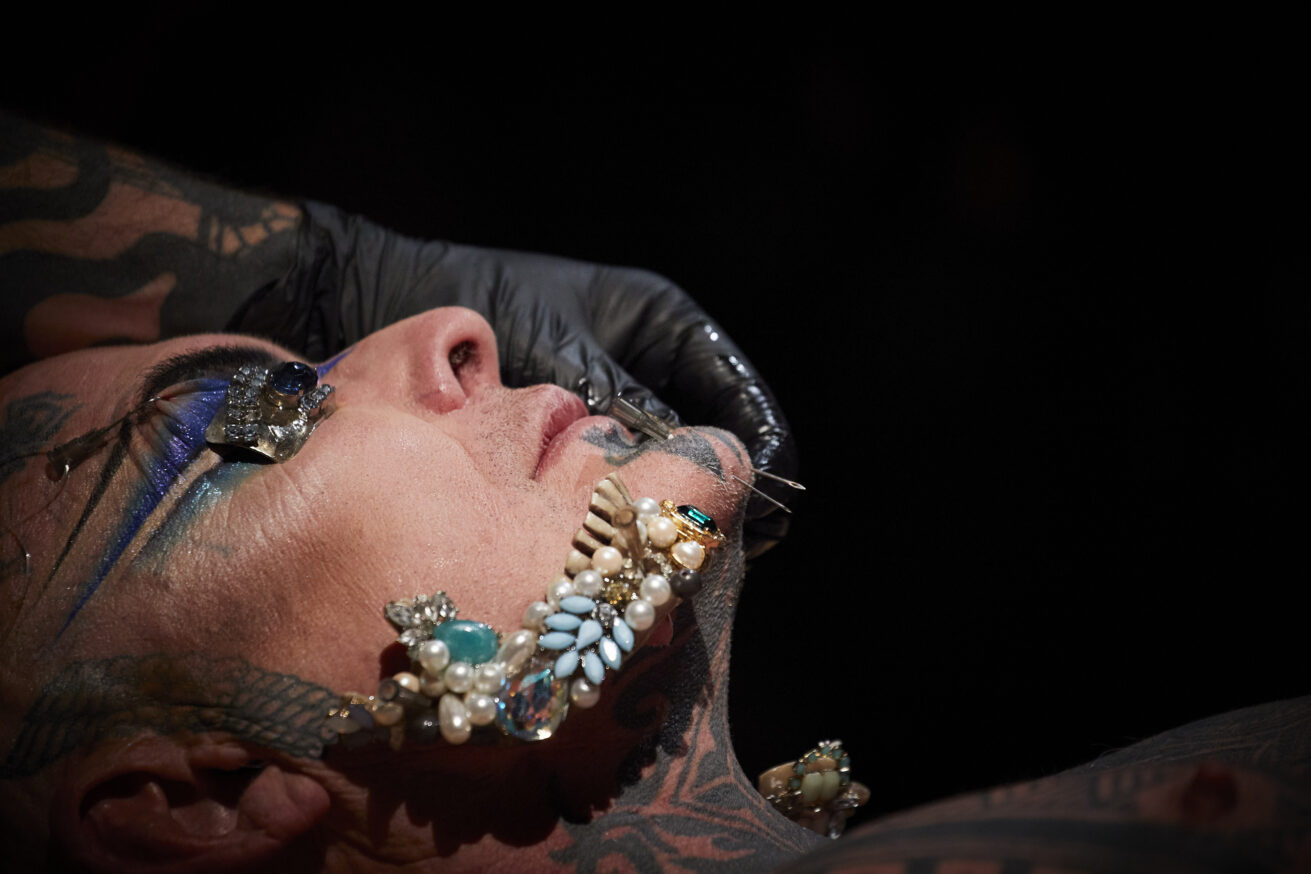
CEREMONY 2026 presents the international premiere of ASCLEPEION, a new work by Ron Athey, staged in the larger-capacity space Unit 8, Copeland Park. Five years in the making, ASCLEPEION is a ritual performance installation rooted in Athey’s lifelong exploration of the body as a site of healing, sacrifice, ecstasy, and transformation. Audiences are invited to step into an immersive environment where the mythic imaginary of Ancient Greece melds with industrial architecture and imagery drawn from Athey’s own long engagement with Los Angeles’ body modification, punk and performance scenes.
ASCLEPEION brings ancient practices of purification, prophecy, dream incubation and votive offering into collision with the ecstatic Pentecostal healing of Athey’s youth, the HIV/AIDS and COVID-19 pandemics, somatic therapy, and strange science. Developed through field research with longtime collaborator Hermes Pittakos at the ancient sites of Eleusis, Delphi and Epidauros, ASCLEPEION reimagines the ancient healing temple as a living, contemporary ritual environment.
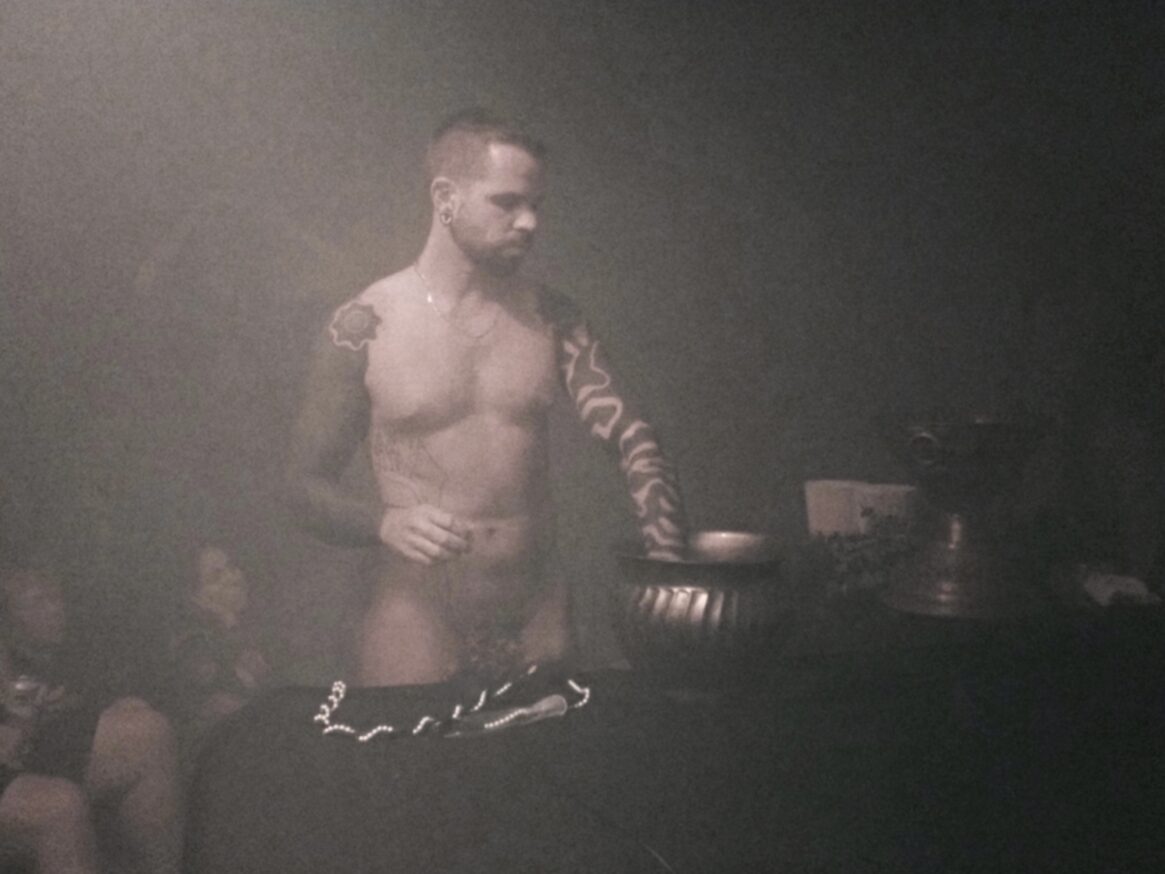
For this large-scale work, Athey has gathered an international cast of collaborators. Multidisciplinary artist and craftsman Hermes Pittakos (Greece) represents the Hierophant, who interprets sacred mysteries; extreme vocal and performance artist Carmina Escobar (Mexico/US) channels the Pythia, who offers prophecy via a new industrial soundscape; choreographer Federica Dauri (Italy) plays Hygieia, the goddess of healing; and sculptor Myrgon (Greece) embodies a shapeshifting Dionysus, who transforms throughout the work, as Myrgon sculpts new forms from wet clay. At the centre, Ron Athey becomes a headless statue of Asclepius, a wounded, sexualised, grotesque body invoking the incorruptible flesh and standing in for a missing god.
Athey told QX: “Asclepions were the healing temples of ancient Greece. The two vital components were the waters and the dream chambers. My obsession with healing comes from the Pentecostal tradition that I was raised in. The drama was high and hardcore: there were bowls to collect vomit, and women who acted as modesty police, throwing squares of fabric at some in dresses writhing on the floor. This practice haunted me during the HIV/AIDS pandemic. My 1995 performance Deliverance (an ICA London commission) went through the archetypes of healing, especially the trickster shaman. This is very much a continuation of that, brought forward to the post-Covid world and the era of preventative HIV medicines.”
Costume designer and artist Stacy Ellen Rich will create original costumes and rework pieces from Athey’s mythic canon, including a series of cult gowns for a community chorus of 13 ablutionists, who brush their hair for the duration of the work, functioning as an autonomous psychic machine.
About Ron Athey
Ron Athey (US, b.1961) has been a prolific and influential performance artist for the past four decades. Raised and based in Los Angeles, Athey’s self-taught practice developed out of post-punk/pre-goth scenes in America. A singular example of lived creativity, his radical performances are often at odds with the art worlds and art marketplaces that have increasingly dominated contemporary art and performance art over the period of his career. @ronathey_4