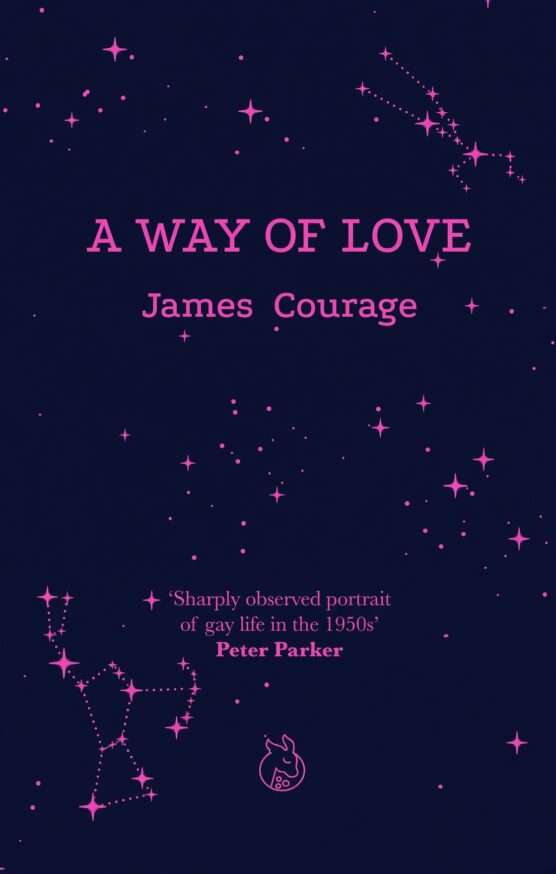
James Courage’s A Way of Love is the story of architect Bruce and his relationship with a younger man, Philip. Published in Britain in 1959 (where Courage was living at the time), it is widely regarded as the first queer novel written by a New Zealander. And for the first time in sixty years, it is available to read through the recent republication by Lurid Editions. This queer text offers key insights into the lives, struggles – and joys – of queer men in the late 1950s. Far from being exclusively a time of repression and persecution, the novel represents an important moment of change and freedom, arriving as it did on the cusp of the sexual revolution.
The late 1940s and early 1950s were a particularly difficult time to be queer. The police force had an influx of men returning from the war. This increased the number of officers patrolling the streets, while ‘vice squads’ were expanded to police increasingly visible queer social life. On a national level, a Conservative government was elected in 1951, and the homophobic Sir David Maxwell Fyfe became Home Secretary. In the United States, McCarthyism and the ‘lavender scare’ influenced perceptions in Britain that queer people were threats to national security. All of which meant greater persecution of queer people. In 1942, there were around 200 ‘queer incidents’ that resulted in criminal proceedings in London. By 1952, this figure had tripled to around 600.
But change was on its way. In 1953, the actor John Gielgud was arrested for importuning. Shortly after, in 1954, Lord Montagu, Peter Wildeblood, and Michael Pitt-Rivers were arrested for homosexual crimes in what became known as the Montagu Trial. But instead of the expected outcry, the mood of the public was largely sympathetic and blamed the government for overreaching. A committee was appointed to examine the law in relation to sexual acts between men (sexual acts between women were never criminalised in Britain). In 1957, the Wolfenden Report recommended that sexual activity between two consenting men – above the age of 21, in private – be decriminalised. It took another ten years for the recommendations to become law in the Sexual Offences Act 1967, but the report itself generated a new sense of political movement at the end of the 1950s. The Homosexual Law Reform Society and its charity, the Albany Trust, were founded in 1958. This new spirit of reform coincided with reforms to other areas of the law that impacted the lives of queer people. Notably: in what they could read.
From the 1860s, books could be prosecuted for obscenity if they had any ‘obscene’ content in them. Importantly, any positive depiction of homosexuality was seen as inherently obscene. This was how Radclyffe Hall’s queer classic The Well of Loneliness managed to be prosecuted in 1928. The novel contains no explicit sexual scenes; instead, its crime was to portray sympathetically the relationship between the butch or trans masculine Stephen Gordon and their femme girlfriend Mary Llewellyn. So for about thirty years, British publishers were wary of publishing novels with queer characters. When they did publish these ‘homosexual novels’, they took great pains to ensure they were ‘toned down’ and, often, read by solicitors.
Which isn’t to say there was nothing for queer people to read. In 1953, two landmarks of British queer fiction – Mary Renault’s romance The Charioteer and Adam de Hegedus’s detective novel The Heart in Exile – were published. A slow but steady output followed. These were a mix of British novels and imports from the United States, such as James Baldwin’s Giovanni’s Room (1956). Likewise, physique magazines – filled with scantily-clad musclemen – were available for purchase at news stalls or through the post. Queer people also colonised the personals sections of left-leaning newspapers such as the New Statesman and the cultural magazine Films and Filming.
But the passing of the Obscene Publications Act of 1959 brought a significant change. The Act allowed authors to argue that what they wrote was in the service of art or literature. They were now also allowed to argue that the book had to be read ‘as a whole’ – no longer could a single passage ensnare it in an obscenity prosecution. After Lady Chatterley’s Lover – banned in England for decades because of its language and frank depiction of sex – survived an attempted prosecution in 1960, publishers felt much freer to take risks on ‘salacious’ novels, including queer ones. From 1950-1959 there were about 150 queer novels published; from 1960-1969, that figure nearly doubled.
These late-1950s changes in what could be published reflected a loosening of restrictions in wider British society. Adolescents stopped being adolescents and became ‘teenagers’. Elvis Presley records were available for sale. On stage, Shelagh Delaney’s play A Taste of Honey (1958), with its interracial relationship and queer supporting character, managed to make its way to the West End. In 1961, the word ‘homosexual’ was uttered on British film screens for the first time in Victim.
James Courage’s A Way of Love was published amid this moment of change. And in many ways the book itself has one foot in the more restrictive 1950s and one in the more easy-going 1960s. The novel is open about the relationship between architect Bruce and the younger man Philip. At one point, Bruce holds Philip in his arms to reassure him: ‘I love you, Philip. I love you very much. Don’t worry’ (p. 117). We might not think one man saying to another ‘I love you’ to be very groundbreaking – but in 1959, this was radical. But notice the dust-jacket, with its white lettering against an orangey-red background. What’s missing is any kind of illustration. Which is odd, because all of Courage’s other novels had illustrations on their dust-jackets. And if we look at the blurb, we’ll see that the relationship between Bruce and Philip is called a ‘passionate friendship’. As if to say: we’ll let you write what you want, so long as you don’t shove it in our faces. An attitude that many queer people may still find familiar today.
More About A Way of Love
Lurid are re-publishing A Way of Love, a lost classic of gay literature by James Courage, which was originally published by Jonathan Cape in 1959. Its distribution was banned in James’s native New Zealand in 1961 and, since 1998, New Zealand has ‘Courage Day’ – a day that commemorates its banning to highlight ongoing concerns about freedom of expression.
A Way of Love is available now: https://www.lurideditions.com







![The Rising in London's SE1 is an LGBTQ] bar that has many LGBTQ] social events](https://www.qxmagazine.com/wp-content/uploads/2024/09/imageedit_26_9160770370-728x410.jpg)